





Four Types of Exchange Activities
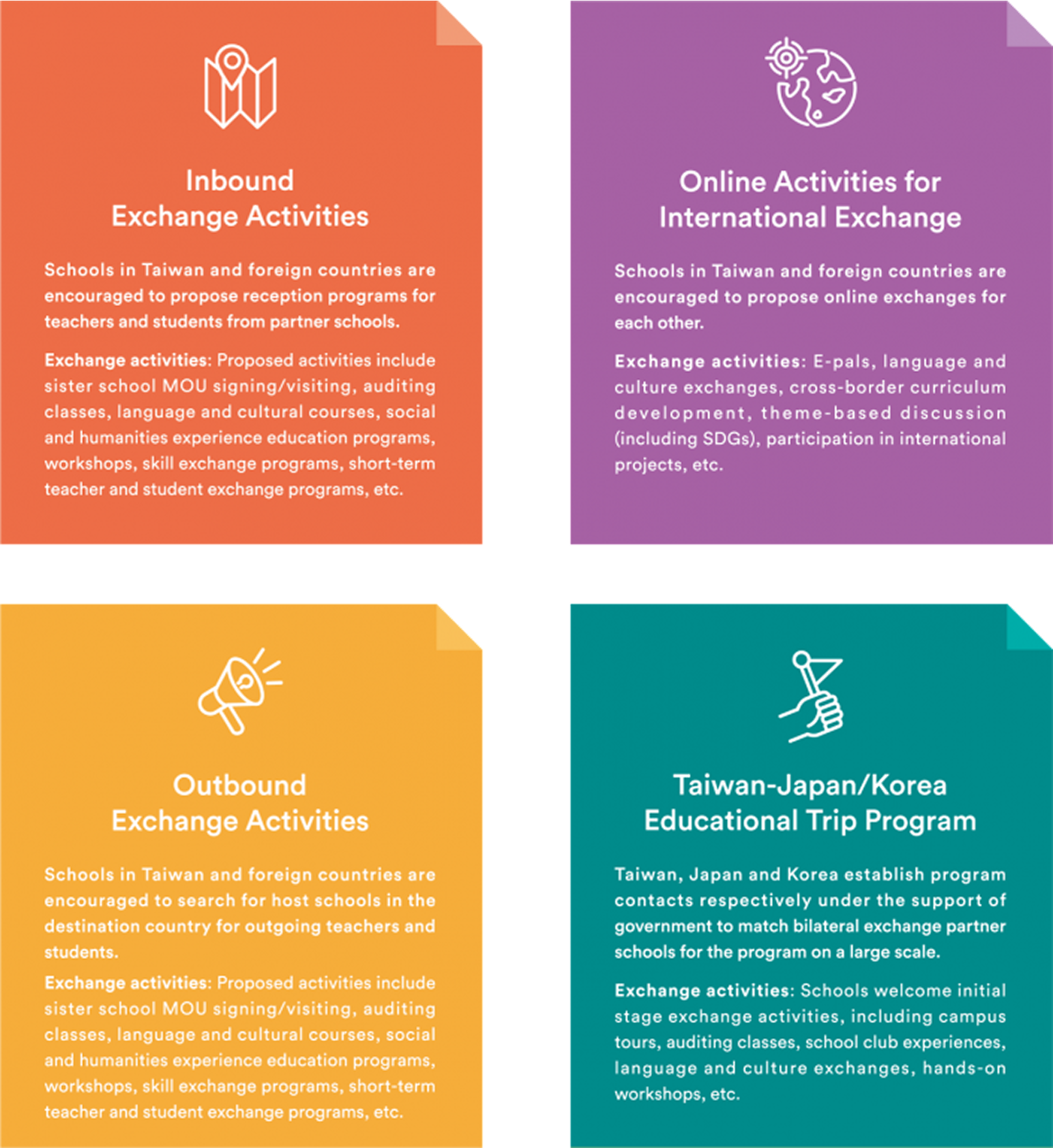
Image description: Four types of exchange activities
Four coloured cards, each with an icon, describing the four types of exchange activities on TPSF.
- Inbound Exchange Activities
- Schools in Taiwan and foreign countries are encouraged to propose reception programs for teachers and students from partner schools.
Exchange activities: Proposed activities include sister school MOU signing/visiting, auditing classes, language and cultural courses, social and humanities experience education programs, workshops, skill exchange programs, short-term teacher and student exchange programs, etc. - Online Activities for International Exchange
- Schools in Taiwan and foreign countries are encouraged to propose online exchanges for each other.
Exchange activities: E-pals, language and culture exchanges, cross-border curriculum development, theme-based discussion (including SDGs), participation in international projects, etc. - Outbound Exchange Activities
- Schools in Taiwan and foreign countries are encouraged to search for host schools in the destination country for outgoing teachers and students.
Exchange activities: Proposed activities include sister school MOU signing/visiting, auditing classes, language and cultural courses, social and humanities experience education programs, workshops, skill exchange programs, short-term teacher and student exchange programs, etc. - Taiwan-Japan/Korea Educational Trip Program
- Taiwan, Japan and Korea establish program contacts respectively under the support of government to match bilateral exchange partner schools for the program on a large scale.
Exchange activities: Schools welcome initial stage exchange activities, including campus tours, auditing classes, school club experiences, language and culture exchanges, hands-on workshops, etc.

How TPSF Functions
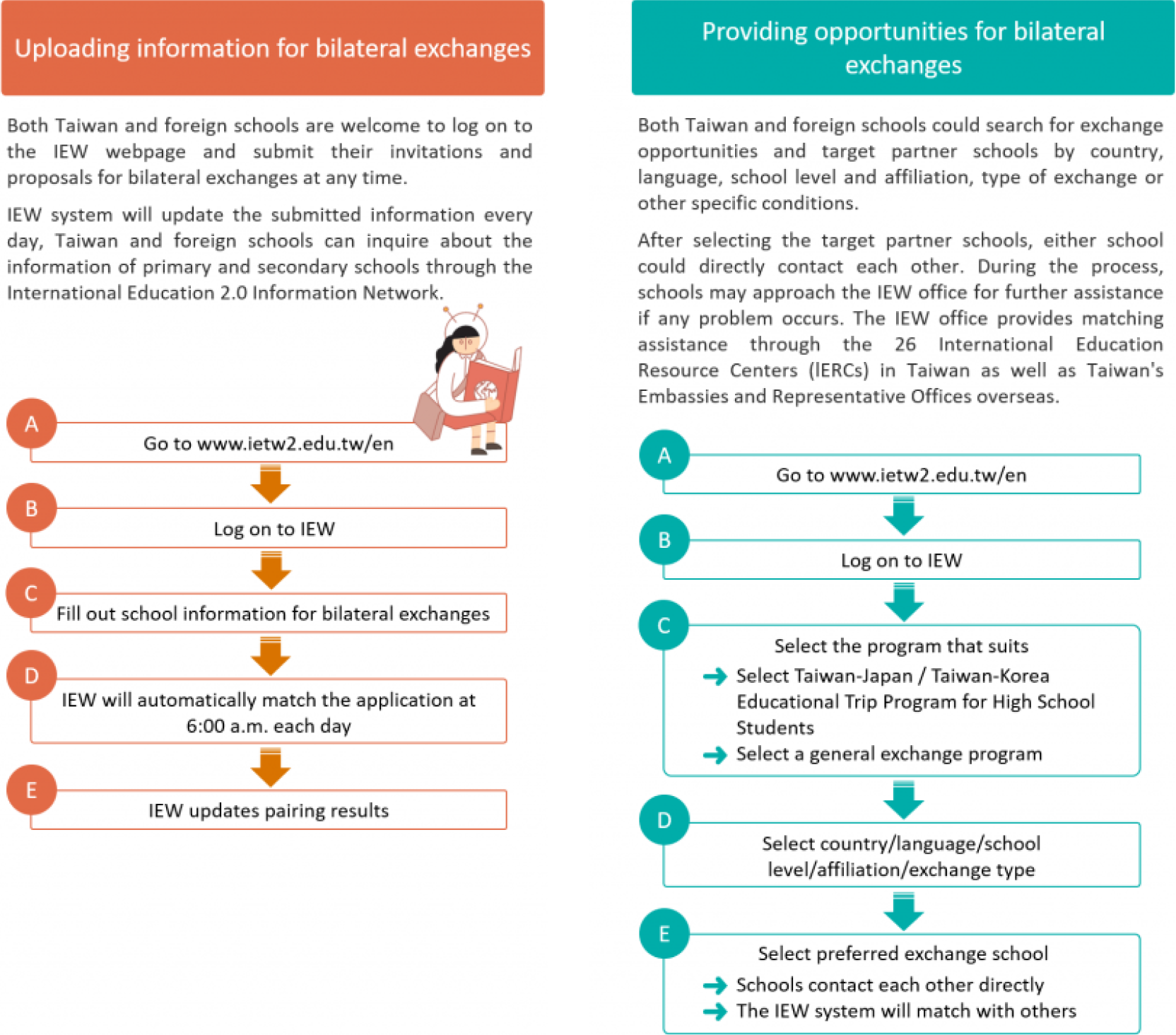
Image description: How TPSF functions: two flowcharts for bilateral exchanges
Two flowcharts showing the two functions of IEW (TPSF).
Uploading information for bilateral exchanges
Both Taiwan and foreign schools are welcome to log on to the IEW webpage and submit their invitations and proposals for bilateral exchanges at any time.
IEW system will update the submitted information every day, Taiwan and foreign schools can inquire about the information of primary and secondary schools through the International Education 2.0 Information Network.
- A: Go to www.ietw2.edu.tw/en
- B: Log on to IEW
- C: Fill out school information for bilateral exchanges
- D: IEW will automatically match the application at 6:00 a.m. each day
- E: IEW updates pairing results
Providing opportunities for bilateral exchanges
Both Taiwan and foreign schools could search for exchange opportunities and target partner schools by country, language, school level and affiliation, type of exchange or other specific conditions.
After selecting the target partner schools, either school could directly contact each other. During the process, schools may approach the IEW office for further assistance if any problem occurs. The IEW office provides matching assistance through the 26 International Education Resource Centers (IERCs) in Taiwan as well as Taiwan's Embassies and Representative Offices overseas.
- A: Go to www.ietw2.edu.tw/en
- B: Log on to IEW
- C: Select the program that suits
- Select Taiwan-Japan / Taiwan-Korea Educational Trip Program for High School Students
- Select a general exchange program
- D: Select country/language/school level/affiliation/exchange type
- E: Select preferred exchange school
- Schools contact each other directly
- The IEW system will match with others

Looking for Taiwan School Partners
Searching for Partners based on collaboration methods, languages, school level and types of exchange activities